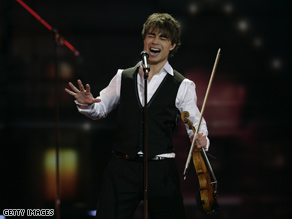
Alexander Rybak of Norway performs during the final of the Eurovision Song Contest Saturday in Moscow, Russia.
The boyish Rybak -- who performed a self-composed tune, "Fairytale," with some deft dance steps and a smile plastered on his face -- won with 387 points, the most in the contest's 53-year history, organizers said.
It was the third time Norway has won the competition. Although the classically-trained Rybak grew up outside the Norwegian capital, Oslo, he was born in Belarus.
A television audience estimated at more than 100 million people watch the show.
In years past, winners have parlayed their victory in varying degrees of success -- most notably the Swedish quartet ABBA, which won with "Waterloo" in 1974 and became one of the most successful pop groups of the 1970s.
In the Eurovision Song Contest, which began in 1956, each participating European nation submits one singer or group who then perform a specially-written song. Telephone votes as well as judges from each country decided the winner this year.

Earlier police arrested dozens of gay and lesbian rights activists who were planning a rally to coincide with the contest. The protesters wanted to draw attention to what they call widespread discrimination of gays in Russia.
